









Apple announced the M5 Pro and M5 Max chips recently, and their benchmarks have already leaked online, showcasing how fast the machines are compared to industry standards. It also suggests that Apple may already be building a chip powerful enough to blur the lines between its top laptop silicon and its desktop-class Macs, which is exactly why the M5 Ultra story suddenly feels much bigger than expected.
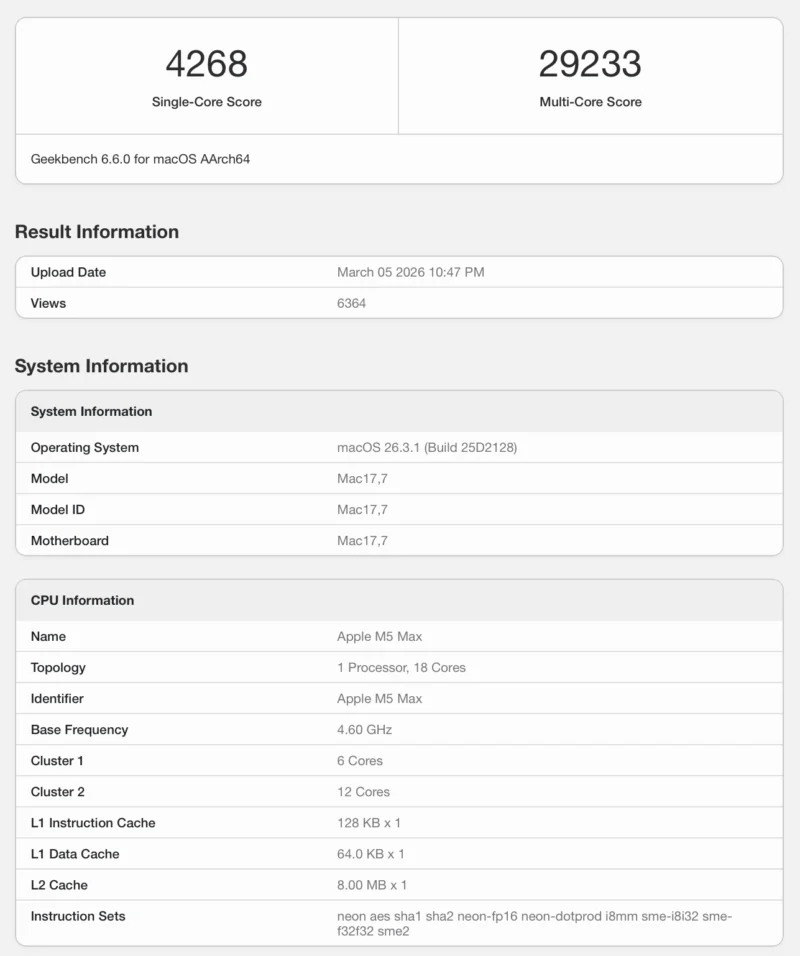
According to the first public Geekbench 6 results, the 18-core M5 Max scored 4,268 in single-core and 29,233 in multi-core. If these numbers stick at this level once retail units ship, Apple is not just delivering another tidy yearly refresh, but also pushing the top end of the Mac lineup into a much more aggressive place.
Early M5 Max Scores Already Suggest Apple’s Next Ultra Chip Could Push Desktop-Class Mac Performance Much Higher
The benchmark itself is what pulls our interest first, corresponding to the identifier Mac17,7, which would line up with the upcoming 16-inch MacBook Pro. The same test also posted a Metal score of 232,718, which appears to be significantly higher than the M4 Max chip.
Take note that we should take these scores with caution, which is the boring but necessary adult disclaimer here, but these are still the kind of numbers that make people sit up straight and start doing an unhealthy amount of tab switching. From what we can see, doing simple math, the single-core performance is 9 percent faster and the multi-core performance is 13.7 percent faster when compared against the M4 Max chip.
The entire thing becomes more interesting once you compare it with older high-end Apple chips that already have broad Geekbench Browser averages behind them. Check out the scores below for a better performance comparison.
- 2025 Mac Studio with M3 Ultra: 3,202 in single-core and 27,727 in multi-core
- 2023 16-inch MacBook Pro with M3 Max: 3,128 in single-core and 20,960 in multi-core
- 2024 16-inch MacBook Pro with M4 Max chip: 3,915 in single-core and 25,702 in multi-core
When you put these numbers against the M5 Max chip, the entire picture changes very fast. We can see that the M5 Max average score in Geekbench Browser sits roughly 33 percent ahead of the M3 Ultra chip in single-core and 5 percent ahead in multi-core, while the gap over the M3 Max chip is much larger. This is not normal at all, as a laptop-class chip is directly competing with and beating Apple’s workstation-class silicon.
Why A Laptop Chip Catching M3 Ultra Actually Matters To Real Buyers
This is the area where benchmarks stop being nerd stats and start becoming a buying story for different kinds of customers. Apple’s performance ladder is supposed to feel simple, where ‘Pro’ is strong, ‘Max’ is stronger, and ‘Ultra’ is where the monsters live. If the M5 Max is already matching or edging past the M3 Ultra in a benchmark that a lot of readers actually recognize, then that neat hierarchy starts to look a lot less neat. Buyers do not really care about keeping Apple’s product segmentation emotionally comfortable. They care about whether the smaller machine is now powerful enough to make the bigger one harder to justify.
For a lot of pro users, the real question is no longer whether the next MacBook Pro will be fast enough, it is whether Apple is making the Max tier powerful enough to delay, or even cancel, the need for a Mac Studio upgrade altogether. If that shift is happening, it changes how people think about the top end of the Mac lineup. The M5 Max may be the first Apple laptop chip that makes waiting for Ultra feel less necessary, while somehow making the next Ultra even more exciting at the same time. Apple has basically created the hardware version of a very expensive identity crisis.
Apple’s Official M5 Details Make The Leap Easier To Believe
Apple’s own announcement helps this story feel more believable instead of sounding like one rogue benchmark got loose on the internet. Apple says that the M5 Pro and M5 Max use a new Apple-designed Fusion Architecture that combines two dies into a single SoC, and both chips feature a new 18-core CPU architecture.
Apple also says that the M5 Pro and M5 Max use 6 super cores and 12 all-new performance cores, while the M5 Max pairs that CPU with up to a 40-core GPU. On top of that, Apple says M5 Max offers up to 15 percent higher multithreaded performance than M4 Max, supports up to 128GB of unified memory, and raises unified memory bandwidth up to 614GB/s. That does not prove every leaked benchmark will land perfectly, but it does show Apple is not treating M5 as some sleepy little polish pass.
What Is Confirmed And What Is Still A Projection For M5 Ultra
Here is the clean line, because this is where tech coverage gets a little sloppy.
What the current numbers suggest:
- M3 Max: 20,960 multi-core
- M3 Ultra: 27,727 multi-core
- M5 Max: 29,233 multi-core
- Projected M5 Ultra: roughly 39,500 to 43,850 multi-core
The first three numbers are real public benchmark figures or current Geekbench Browser averages. The fourth is not a leak and it is not confirmed hardware data. It is a projection based on the idea that a future Ultra-class part could scale meaningfully from the Max tier the way Apple’s highest-end chips historically have.
If you take the early M5 Max multi-core score of 29,233 and apply a rough scaling range of about 1.35x to 1.5x, you end up in the neighborhood of 39,500 to 43,850. That kind of number would not feel like a routine desktop refresh, but like Apple kicking its own old performance ladder out from under itself.
The Intel And Ryzen Comparison Makes This Story Bigger Than Apple Rumor Coverage
This part matters because it simply broadens the story beyond Apple and rumor watchers, and stretches it to the entire industry. Geekbench Browser currently lists the Ryzen 9 9950X at 3,385 in single-core and 21,443 in multi-core. The Intel Core Ultra 285K is listed at 3,199 single-core and 22,543 in multi-core, while the Core i9-14900K is listed at 3,049 single-core and 20,105 multi-core. On the benchmark front, the early M5 Max result beats all three in both single-core and multi-core performance.
However, that does not mean Apple’s notebook chip automatically wins in every real-world workstation task, especially in systems with stronger cooling, discrete GPUs, or workloads that behave very differently from Geekbench. It does show how far Apple’s CPU performance has moved in a laptop-class design, and that is a much bigger story than just saying that new MacBooks are fast.
Additionally, it creates the more interesting question, which is what this anchor is really about. If the M5 Max already looks this strong against older Apple Ultra silicon and mainstream high-end desktop CPUs in Geekbench, then what exactly is the M5 Ultra supposed to look like when it arrives in a future Mac Studio or Mac Pro? That is the angle that gives this story real weight.
This is not just about one benchmark or one fast MacBook Pro. It is about the possibility that Apple’s next desktop-class chip could push the performance ceiling even higher while keeping the efficiency advantage that has defined Apple silicon from the start. If the early M5 Max result is even mostly representative of retail performance, then this may be the clearest hint yet that the M5 Ultra could become one of Apple’s biggest CPU leaps in years.
Leave A Reply