





Google’s next flagship chip was supposed to narrow the performance gap with the competition, especially the iPhone, but the first signs suggest something else entirely. Early benchmark listings for the Tensor G6 chip have surfaced online, and instead of signaling a breakthrough, they quietly highlight how far ahead Apple’s custom silicon architecture has moved. The numbers alone do not tell the full story, but they reveal enough to shape expectations.
Early Tensor G6 Benchmarks Suggest Incremental CPU Changes, Not A Leap
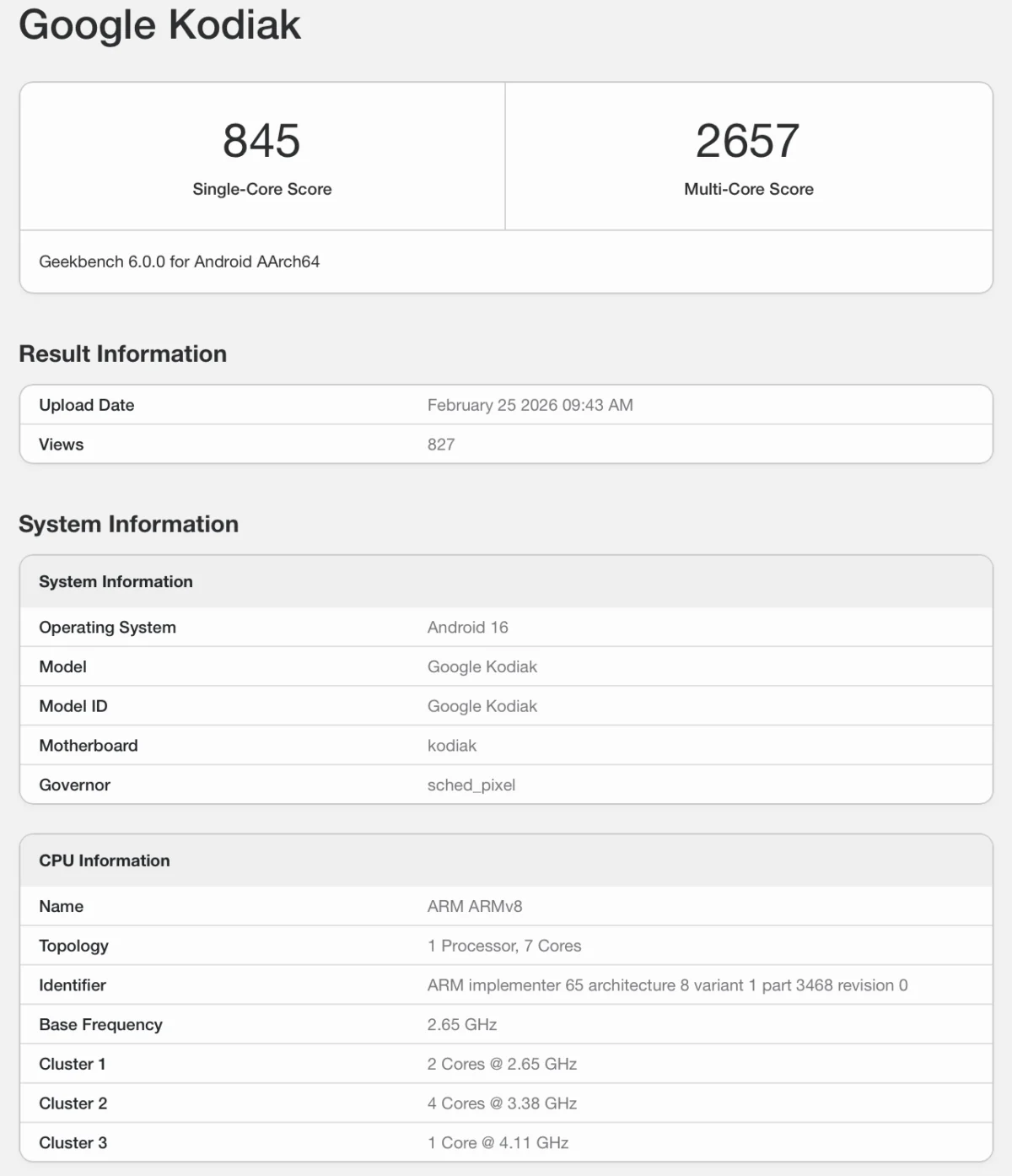
A recent Geekbench 6 listing shows Tensor G6 scoring 865 points in the single-core department and 2657 in the multi-core tests. Even allowing for pre-release firmware and tuning adjustments, these figures point to modest refinement rather than a structural redesign of Google’s CPU approach.
Reports suggest a 7-core configuration featuring a high-clocked prime core supported by a reduced performance cluster. This change may help with better thermal management and efficiency, but it does not alter Google’s long-standing philosophy. Tensor continues to prioritize AI acceleration, computational photography pipelines, and contextual machine learning over raw CPU throughput.
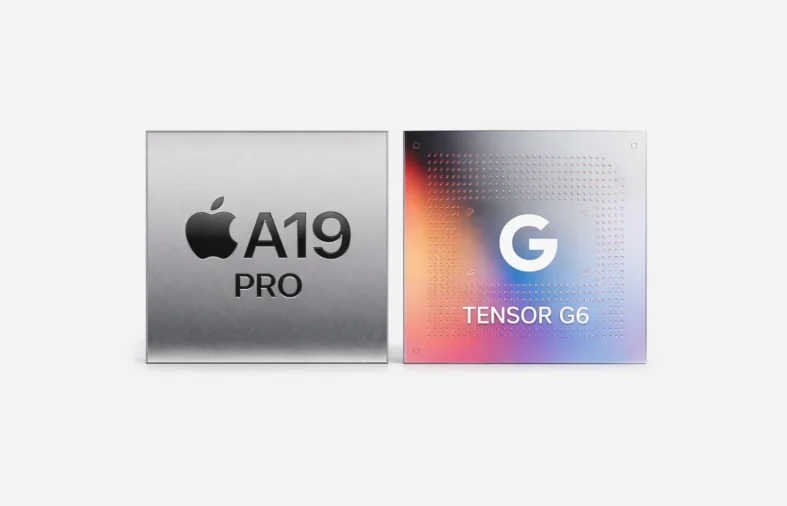
Apple’s A19 Pro and Google’s Tensor G6 compared as early benchmarks reveal a noticeable performance gap.
Check out the key takeaways from the early data:
- CPU performance remains below current flagship Apple silicon
- AI and ISP acceleration likely remain Google’s primary strengths
- Architectural changes focus on efficiency rather than peak compute
Apple’s A19 Pro Still Commands The High Ground In Pure Performance
When compared against Apple’s A19 Pro chip in the iPhone 17 Pro lineup, the contrast becomes clearer. The A19 Pro is posting Geekbench 6 scores near 3900 in single-core and close to 9700 in multi-core performance. This is not a narrow gap at all, as it reflects Apple’s wide high-performance cores, aggressive IPC tuning, deep cache design, and vertical integration across hardware and software. Moreover, with the iPhone 18 Pro launching later this year, the A20 chip will further take a lead against the competition.
Technically speaking, Apple’s approach allows sustained high-frequency execution without compromising efficiency, something that only a few mobile SoCs manage consistently. This has also allowed Apple’s chips to be so powerful that the company is planning to put an A18 Pro chip inside a budget MacBook. While Tensor G6 may double down on AI workloads and system-level intelligence, it does not appear to challenge Apple in raw CPU dominance based on current data.
Google’s compensation strategy is obvious. Rather than chasing synthetic leaderboard wins, it is betting on differentiated AI features that influence everyday usability. However, when the discussion shifts to peak compute capability, Apple’s A19 Pro continues to operate in a different performance tier.
Take note that the final retail results of the Tensor G6 may adjust slightly as firmware matures, yet the broader architectural narrative remains the same. What do you think about the numbers? Let us know in the comments below.
Leave A Reply