




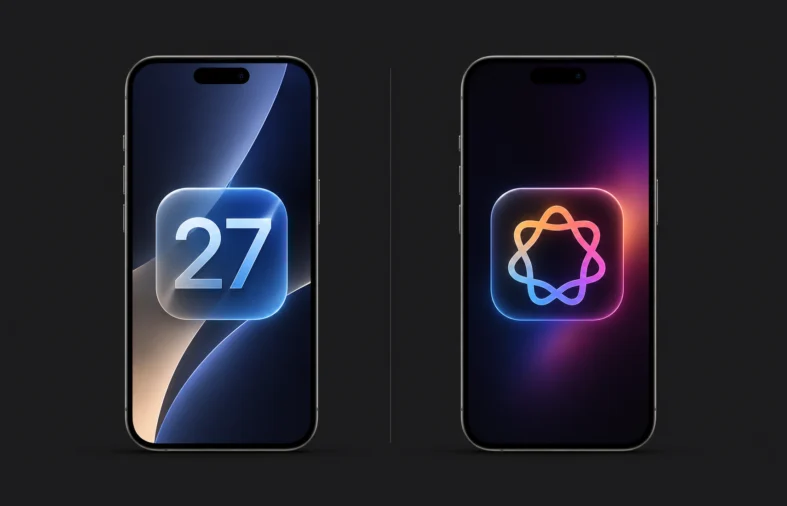

If you’re planning to install the iOS 27 beta right now or looking forward to it, you might discover that some AI features are nowhere to be found. Well, you’re not alone, as many users are still confused about what they’ll actually get in the fall. Many assume that installing the latest version of iOS automatically unlocks every new capability Apple announces, but that’s no longer how things work. Apple has quietly split software support from AI support, creating a compatibility system that’s more complicated than ever.
iOS 27 And Apple Intelligence Are Two Different Things
For many years, updating your iPhone to the latest version of iOS meant users received nearly every headline feature the company announced on stage. Well, Apple Intelligence has changed that expectation.
Today, your device has to pass three separate compatibility checks:
| Compatibility Layer | What It Means |
|---|---|
| iOS 27 Support | Your iPhone can install and run the latest version of iOS. |
| Apple Intelligence Support | Your device meets Apple’s minimum hardware requirements for Apple Intelligence. |
| Feature Support | Some Apple Intelligence features may require newer chips, more memory, or a later software update. |
That’s why two iPhones running iOS 27 can still have different Apple Intelligence experiences. Software compatibility simply gets your device through the front door, but your hardware determines what happens next. If you’re looking for the complete list of iOS 27 compatible iPhones, check out our dedicated guide.
Apple Intelligence Supported iPhones
Apple Intelligence is currently available on the following iPhone models:
- iPhone 15 Pro
- iPhone 15 Pro Max
- iPhone 16e
- iPhone 16
- iPhone 16 Plus
- iPhone 16 Pro
- iPhone 16 Pro Max
- iPhone 17
- iPhone Air
- iPhone 17 Pro
- iPhone 17 Pro Max
If your iPhone isn’t on this list, you’ll still receive iOS 27 and its standard features, but Apple Intelligence won’t be available because your device doesn’t meet Apple’s hardware requirements.
Why Hardware Matters More Than Ever
Apple Intelligence relies heavily on on-device processing before turning to Private Cloud Compute for more demanding requests. That approach improves privacy and reduces delays, but it also requires significantly more computing power than traditional iPhone features.
The Neural Engine, available memory, and overall chip performance all play a role in deciding whether your device can run Apple’s AI models smoothly. Rather than offering slower or inconsistent performance on older hardware, Apple limits Apple Intelligence to devices that can meet those performance expectations.
It’s a strategy that we’re already familiar with. Features like ProMotion and Always-On Display weren’t limited by iOS versions but by hardware, and Apple Intelligence follows the same philosophy.
Apple has also introduced several new AI capabilities in iOS 27 that build on this hardware foundation.
Apple Intelligence Is No Longer All-Or-Nothing
Another reason users are confused is that Apple Intelligence isn’t a single feature but a growing platform, and it could give the company more reasons to create differentiation in its iPhone lineup.
Some capabilities are available across every supported Apple Intelligence device, while others are introduced alongside newer chips or arrive in later software updates. Over time, compatibility is becoming increasingly feature-specific instead of device-specific.
What this means is that owning an Apple Intelligence-compatible iPhone doesn’t necessarily guarantee access to all the shiny new features Apple announces in the future.
So, Should You Upgrade?
If you’re happy with your current iPhone and rarely use AI-powered tools, upgrading solely for Apple Intelligence probably isn’t necessary.
However, if you regularly use writing assistance, smarter Siri interactions, image generation, or other AI features, moving to a supported device is a worthwhile investment. Not only will you gain access to today’s Apple Intelligence capabilities, but you’ll also be better positioned for future AI features as Apple’s platform continues to evolve.
Apple Intelligence marks a fundamental shift in how iPhones improve over time. For years, upgrading mainly meant getting a better camera or a faster chip. Increasingly, the biggest difference between iPhones may be the AI experiences their hardware can unlock. Understanding that distinction explains why installing iOS 27 doesn’t automatically give every supported iPhone the same Apple Intelligence features.
Leave A Reply